.png)
How social media went from posting for fun for posting on purpose
Somewhere in your camera roll is a photo you'd never post today—not because it's bad, but because you can suddenly picture exactly who might see it. Colleagues. Clients. Some important clients you will meet three weeks from now.
That pause before you post.
We are all obsessed with how we look online rather more than how we actually look like in real life to our own family and friends.
Sociologists would call this: impression management—the constant unconscious calibration of how we would appear to different audiences. We once saved this for first dates, job interviews, seeing your ex for the first time since the big breakup. And yet here we are, taking thirty identical photos just to post one perfect picture on our Instagram story, carefully choosing the perfect song, perfect caption, seen once by two hundred people who'll forget it within five minutes.
In the world full of constant fear of judgment from total strangers, I couldn’t help but wonder if a personal brand was ever really about us. About what we eat, where we go, how we live, what we think. Or if it’s always been a performance of how we want to be seen by whoever happens to be looking.
When a Bad Post Was Just a Bad Post
Facebook used to be family dinners and tagged photos nobody remembers asking for, a cousin's wedding album with two hundred pictures nobody would ever scroll through twice, a caption that was just the location because that was enough. Used to be. Instagram was the same kind of low-stakes: a meal at a nice restaurant, spring in Kyoto, a photo you posted because you looked good that day and that was reason enough on its own.
Nobody outside your circle was watching, which meant nobody inside it was performing. A blurry photo from someone's house party, an inside joke that only three people would ever understand—none of it mattered, because none of it was being read as evidence of who you actually were. There was no audience evaluating your judgment, your career prospects, or your character based on a post from last Friday night out.
What changed was not the honesty of the post or the character of the person posting it. It was the quiet disappearance of a boundary that used to sit between the audience you were writing for and every other audience that might eventually see it. Once that boundary collapsed, a post stopped being a single message read by a single kind of reader, and became something closer to a public document, open to interpretation by anyone who happened to encounter it, regardless of whether they were ever meant to.
Before the Internet Made It Unavoidable
A full decade before Facebook opened to the public and long before anyone started posting an ice bath as proof of discipline, in 1997, Tom Peters wrote "The Brand Called You."
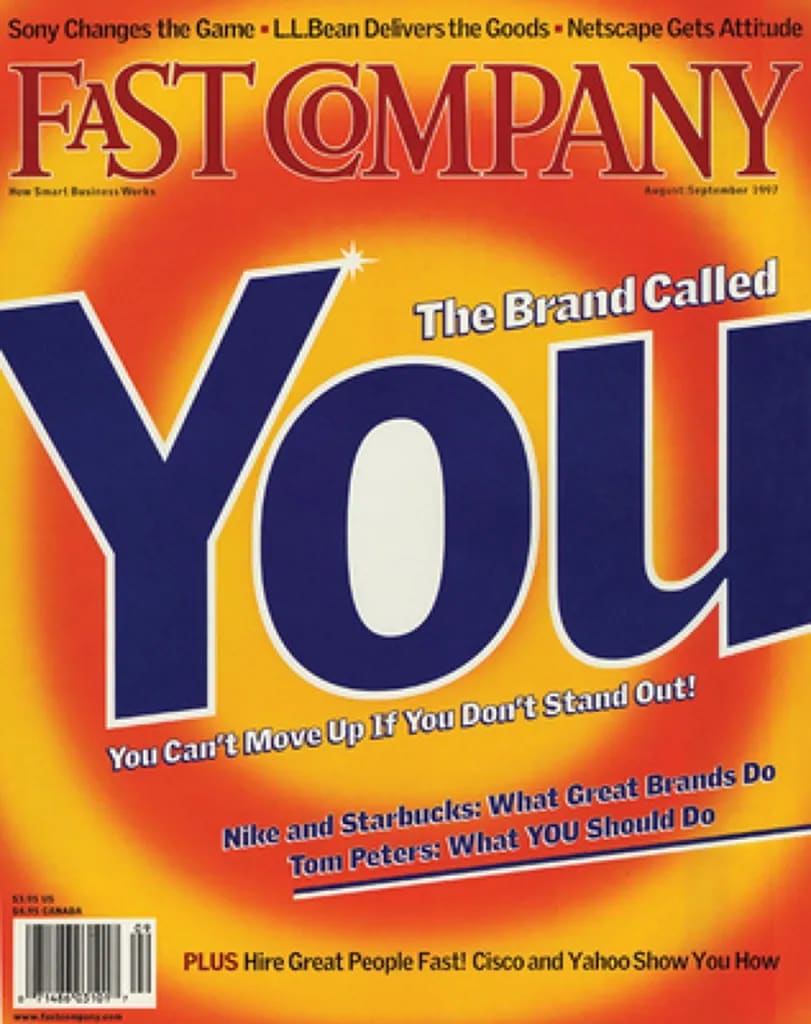 Source: Fast Company, Issue 10, August/September 1997
An individual functions as a brand in exactly the way a company does, subject to the same logic of differentiation, reputation, and perceived value.
"It's this simple. You are a brand. You are in charge of your brand."—Tom Peters, 1997
This was true long before anyone had a platform built to broadcast it. His argument was that every professional functions as a brand whether they like it or not, and that career security, in an economy that no longer guarantees loyalty in either direction, would come down to whoever did that job on purpose.
It was at a particular moment in the American economy—a wave of corporate mergers had just consolidated entire industries. The traditional employer-employee relationship built on decades-long loyalty was visibly eroding, and professional services firms like McKinsey were becoming the model for how talented people would need to operate going forward. Peters was not describing influencers or self-promotion in the sense we now associate with the term. He was describing something closer to professional reputation management: the kind of thing built slowly, through a well-argued internal memo, a conference panel invitation, a byline in a company newsletter, a track record that traveled by word of mouth within an industry rather than across your Instagram page.
What is worth sitting with, reading the essay nearly thirty years later, is how little the underlying claim actually needed the internet to be true.
Peters was not predicting social media.
He had no way to anticipate smartphones, algorithmic feeds, or platforms explicitly designed around personal visibility. What he identified instead was a structural shift in how professional value gets recognized—a shift toward individuals needing to actively manage their own reputation rather than relying on an employer or a title to do it for them. That shift did not require any particular technology to be true. The idea that everyone is a brand did not arrive with social media. Now, it’s just unavoidable.
Visibility Is Your Only Insurance
For most of the twentieth century, a career built on quiet competence and staying in one place long enough was actually a viable plan. You could work at the same company for twenty years, get promoted a few times, retire with a pension, and never once need a stranger outside that building to know your name.
That plan doesn't exist anymore. Singapore's Ministry of Manpower reported retrenchments hit 4,500 workers in the second quarter of 2026 alone—the highest quarterly figure in more than five years. The incidence of retrenchment rose alongside it, climbing from 1.6 to 1.9 per 1,000 employees. Most of it wasn't performance-related. MOM's data shows business reorganisation and restructuring, accounting for the overwhelming majority of layoffs. None have done wrong but only because the company decided to reshape itself around them.
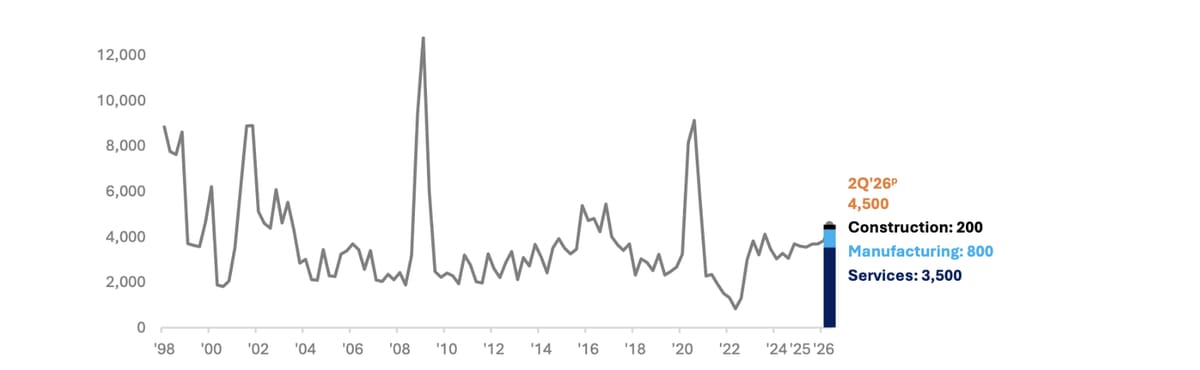 Source: Labour Market Advance Release Second Quarter 2026, Ministry of Manpower, July 2026
Online visibility is not a nice-to-have next to the real insurance—it has quietly become the real insurance. A reputation that only lives inside one company disappears the moment that company restructures. A pension can be restructured. A relationship with a former manager can be restructured. None of that is guaranteed.
Surveys by CareerBuilder and ResumeBuilder consistently put the number at around 70% of employers using social media to screen candidates, with more than half saying they've ruled someone out because of what they found. There's little reason to think Singapore's hiring managers behave differently. Especially, in a market this small and interconnected, there is more temptation to check. A track record others can actually see, your personal brand, is the one asset that doesn't depend on any single company, manager, or relationship.
In Singapore, There’s Nowhere to Hide
In 2016, Facebook measured how many links it takes to connect any two random strangers to each other. Picture it as a chain: you know someone, who knows someone, who knows someone else, who finally knows a stranger you've never met. That chain averaged out to 3.57 people globally. In the United States alone, a more tightly connected country than the world as a whole, the same chain shortened to 3.46. Now see Singapore—smaller still, and wound even tighter: industries small enough that everyone's second job interview is with someone who already knows their first boss. If 3.46 is what a large, dense country looks like, something you posted this afternoon doesn't have to travel far here before it reaches someone who actually matters to you.
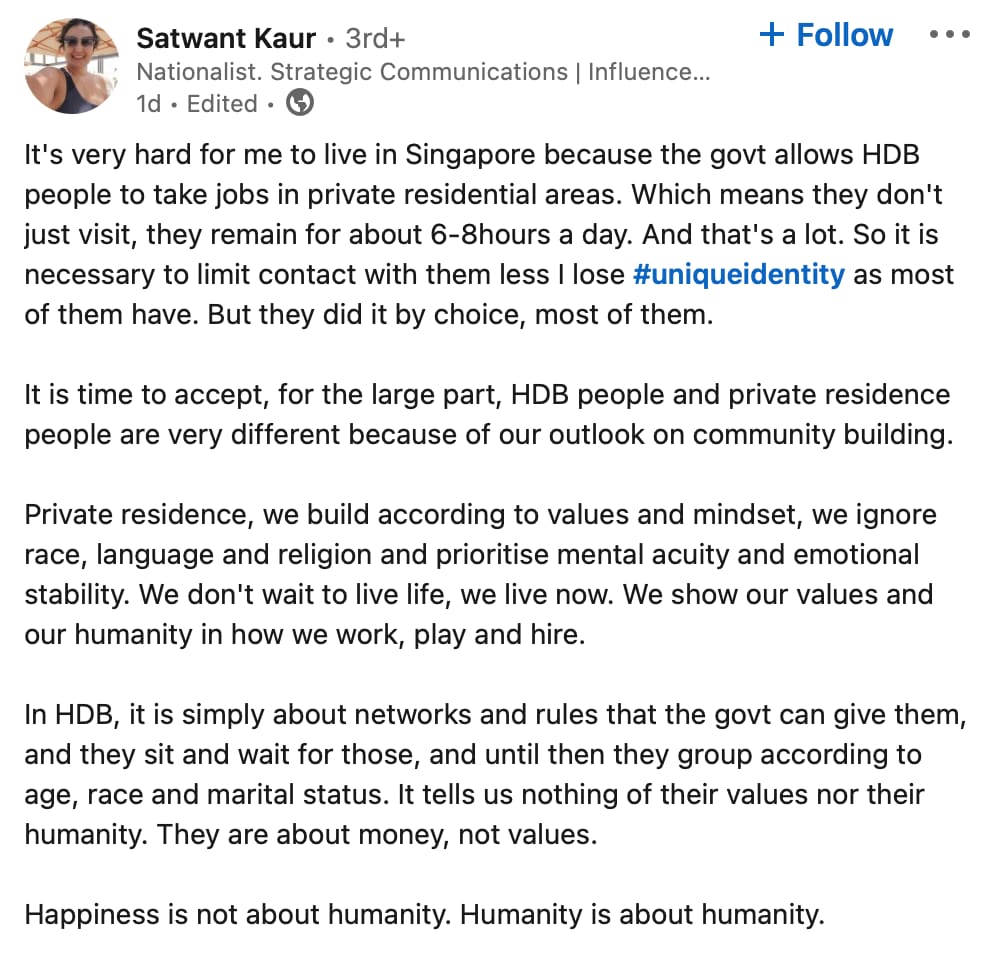 Source: Mothership, 2023
In May 2023, a woman posted on LinkedIn saying she needed to "limit contact" with what she called "HDB people" to protect her "unique identity." Within days, it had spread to Reddit, gathered over 2,500 upvotes and 450 comments, and even drawn a public rebuke from a local actor who had no personal stake in the story whatsoever. And soon after, her account disappeared.
In a city where a bad opinion moves this fast, most personal branding advice doesn't quite apply—it's written for markets where reach is earned slowly and audiences stay roughly where you left them. Here, the story moves faster than you can catch up to. That cuts both ways: a good post travels just as fast as a bad one. This means the margin for error is smaller here than almost anywhere else. In a country this size, three links away is all it takes to reach everyone.
Be Real
Somewhere along the way, personal branding started sounding like a euphemism for pretending—swapping out the real version of yourself for a polished, Instagram-able one designed to perform well online. Even though people treat them as synonyms, being deliberate and being fake are not the same thing. Fake means inventing something that is not true. Deliberate means choosing which true things about you get to be shown. Magazine profiles do this all the time. A journalist spends three hours with someone, and puts together a six-hundred-word piece that readers call authentic.
Nobody expects a magazine profile to include every detail of a person's life, and nobody calls that dishonest. Because that’s authentic.
Because it's edited well, they call it authentic. The editing itself is what makes it read that way: someone decided deliberately which parts of a person actually mattered enough to keep. That decision is the whole skill. Most personal feeds fail at the opposite end—not too polished of course, there’s nothing that feels exactly fake. It just feels random. A vacation in Japan, next to a selfie with someone famous, next to a blurry gym selfie, next to old university throwback photos, and next to nothing at all for six months. Because nothing was ever chosen on purpose.
Yes, that's how my old feed used to be. And that has nothing to do with authenticity. Being authentic and being coherent are two completely different skills that people only ever practice one of them.
Like when Peters said, "Visibility has a funny way of multiplying; the hardest part is getting started." The rest compounds on its own, but only once you've actually decided what you are trying to be known for.
So, where do you draw the line? How much of you actually needs to be seen?